Guest Blog: The Tempo team
Nine out of ten organizations say they encourage adaptability and alignment across all teams.
But stated alignment and actual, operational alignment are not the same. And, at scale, the gap between the two becomes increasingly difficult to manage.
At Tempo Software, we wanted to get past surface-level perceptions. We surveyed 667 planning and PMO leaders in 43 countries for our inaugural 2026 State of Strategic Portfolio Management report. The results paint a picture of a different challenge: organizations aspire to have alignment but cannot achieve it consistently at scale.
A full 87% of respondents say their portfolio priorities are fully or mostly aligned with organizational goals. On the surface, this would suggest alignment is not a concern.
However, in practice, it’s less clear-cut. We asked a follow-up question: “What would most improve your ability to deliver strategic outcomes?” Better cross-functional alignment was the top response.
What this signals is that alignment remains one of the most critical challenges for planning leaders.
Then we looked at what’s getting in the way. According to the report, the two biggest barriers to portfolio-strategy alignment are competing priorities across business units (34.6%) and unclear or changing organizational strategy.
Digging deeper reveals a structural disconnect between perceived alignment and operational reality, which becomes more pronounced as organizations scale and conditions evolve.
This type of misalignment is often invisible within individual teams. A product team's priorities make perfect sense to the product team. Same for engineering, same for finance. The disconnect becomes visible only when initiatives need to span business functions and – the impact on speed, cost, and outcomes has already been felt.
The silo correlation
The data gets more specific when you compare organizations that prioritize alignment against those that don't.
Across the full sample, about 10% of respondents describe their portfolio management processes as siloed. Among organizations that don't encourage alignment, that number is 41.5%. Four times higher.
Silos and misalignment reinforce each other in a continuous cycle. When teams operate in isolation, they optimize for their own goals. Local decisions remain rational, but at the portfolio level, resources drift, visibility declines, and strategic intent becomes diluted.
What misalignment costs
You’ve almost certainly heard that silos create problems for portfolio management. Our data quantifies just how costly this becomes at scale.
The first impact is reduced organizational responsiveness. Across all respondents, 65% say they’re very or extremely confident they can adapt quickly to market or business changes. But for organizations that don’t encourage alignment, fewer than 20% say the same – a 45-point gap.
Similarly, 55% of all respondents can reallocate resources and budgets in under two weeks when market or business conditions change. Among non-aligned organizations, that drops below 33%. These organizations are significantly less equipped to respond as conditions evolve.

And the ROI numbers follow the same pattern. More than 70% of projects are delivering measurable ROI or strategic value, as our research shows. Yet, for organizations that don’t prioritize alignment, it’s less than 54%. Nearly half their projects fail to deliver strategic value.
Encouraging alignment and operationalizing it are fundamentally different
Leadership can put alignment in the company values. They can talk about it at all-hands meetings and include it in OKRs. But unless teams have shared visibility across the portfolio – and integrated tools that connect planning work across business units – alignment remains aspirational rather than executable.
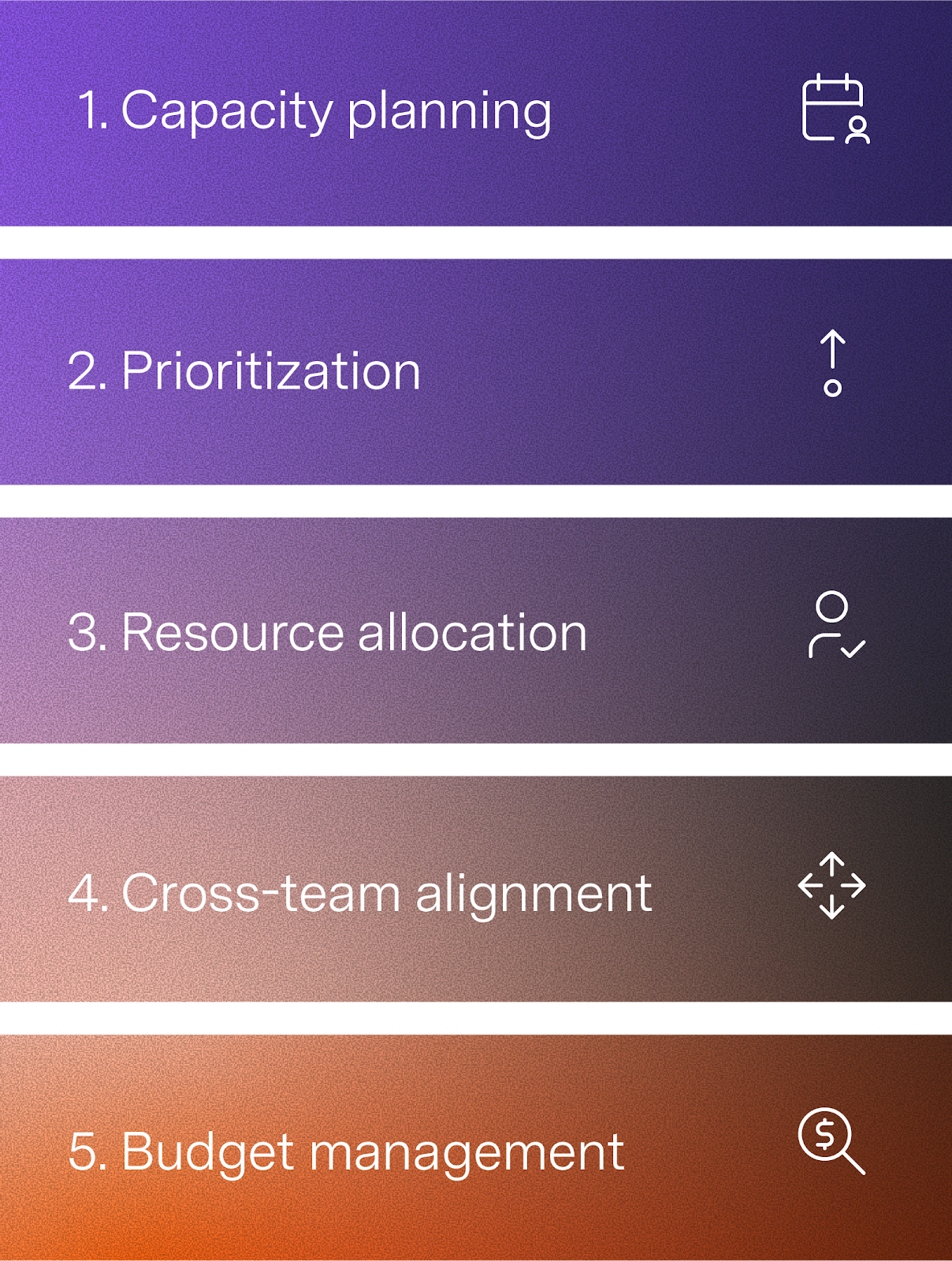
The top execution challenges in the survey point to why. Capacity planning ranked first (29.5% put it at #1), followed by resource allocation and prioritization. These are coordination challenges that require real-time visibility across the portfolio. They require organizations to understand how work, capacity, and priorities interact across teams, not just within them.
An organization that lacks cross-portfolio visibility is forcing leaders to make strategic decisions without a complete view of resources, dependencies, and trade-offs.
What the higher performers look like
Organizations with integrated portfolio management processes – where planning tools and governance are connected across the business, not just within individual teams – report 95% alignment with organizational strategy. They also see 14+ percentage-point better ROI delivery compared to siloed organizations. They can reallocate resources faster and are significantly more confident in their ability to respond to change.
These organizations still deal with competing priorities and shifting strategies. The difference is structural: they have the systems required to continuously adjust and coordinate through change. These systems provide shared visibility, integrated processes, and review cadences that catch misalignment before it compounds.
At scale, this ability to dynamically adjust strategy and execution is not optional. It is a prerequisite for delivering positive outcomes.
For teams working in the Atlassian ecosystem, the tools for portfolio-level visibility and resource planning exist. The critical question is whether these capabilities are connected across the business or whether teams continue to operate in well-structured – but ultimately disconnected – silos.
The full 2026 State of Strategic Portfolio Management report breaks down the data across alignment, scenario planning, review cadence, and more. It provides a benchmark for organizations to assess where alignment breaks down and what must change to deliver strategic outcomes in increasingly dynamic environments.

 Isos Technology
4 MIN READ
Isos Technology
4 MIN READ


 Amanda Kirk
